Getting your civil defence décor approval in Sharjah is one of the most misunderstood—and most consequential—steps in any industrial or commercial fit-out project. Delays at this stage can freeze an entire development, trigger penalty clauses, and in some cases require costly rework of installed systems. Yet surprisingly little practical, step-by-step guidance exists online, especially for specialised sectors like petroleum, warehousing, and high-hazard industrial facilities.
This guide closes that gap. Whether you are fitting out a retail showroom in Al Qasimia, an industrial unit in SAIF Zone, a petroleum storage facility in Hamriyah Free Zone, or a logistics hub on the Sharjah Industrial Area roads, this article gives you the full picture—from the regulatory framework and the approval workflow to selecting a civil defence approved contractor like Midas Electromechanical, and navigating the third-party inspection requirements that most project managers only discover too late.
What Is a Civil Defence Décor Approval in Sharjah?
Civil defence décor approval—often referred to informally as a “décor NOC” or “fit-out clearance”—is the formal sign-off issued by the Sharjah Civil Defence (SCD) confirming that the interior fit-out, fire protection systems, and building services of a premises comply with UAE fire and life safety codes before the space is occupied or operated.
The term “décor” is somewhat misleading. It is not limited to aesthetic finishes or interior design. In the UAE regulatory context, the décor approval covers:
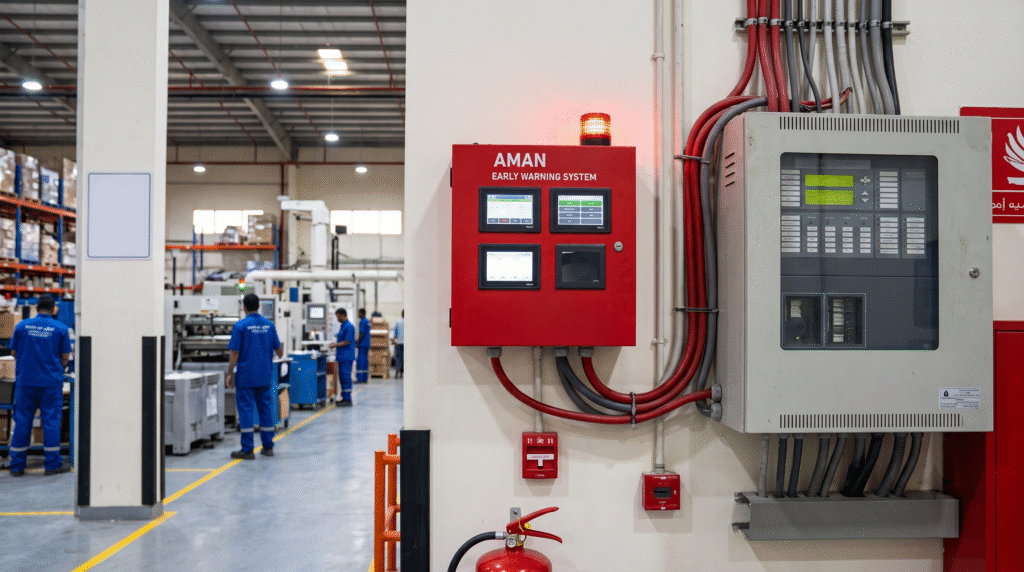
- Fire detection and alarm systems
- Fire suppression and sprinkler networks
- Emergency lighting and exit signage
- Passive fire protection (fire-rated walls, ceilings, and doors)
- Electrical distribution compliance (in coordination with SEWA)
- HVAC smoke control and fire damper installation
- Hazardous material storage layouts (for industrial and petroleum projects)
- Access routes and evacuation pathways
Without this approval, your municipality trade licence renewal, SEWA final connection, and Sharjah Building Control Authority (SBCA) completion certificate will all be blocked.
Civil Defence Décor Approval vs. Building Permit — What Is the Difference?
Many first-time developers in Sharjah confuse the building permit (issued by SBCA) with the civil defence décor approval (issued by SCD). These are two distinct approvals:
The SBCA building permit covers structural works, external envelope, and architectural compliance. The civil defence décor approval, by contrast, is triggered when you install or modify any fire protection system, partition layout, or internal services inside an existing or newly constructed shell. You typically need both, in sequence, with the SBCA permit preceding fit-out and the SCD décor approval preceding occupation.
For industrial projects—especially those involving manufacturing processes, chemical storage, or fuel handling—the civil defence review goes far deeper than a standard commercial fit-out. It includes hazard classification of the activity, special suppression system design review, and in many cases, third-party engineering verification.
The Regulatory Framework — Who Governs Civil Defence Approvals in Sharjah?
Sharjah Civil Defence Directorate
The Sharjah Civil Defence Directorate (SCD) operates under the Ministry of Interior and is the primary authority for all fire safety approvals within the Emirate of Sharjah, including its enclaves (Khor Fakkan, Kalba, Dibba Al Hisn). Its engineering department reviews fire system drawings, inspects installations, and issues NOCs and completion certificates.
The SCD applies two principal codes:
- UAE Fire and Life Safety Code of Practice (issued by the Ministry of Interior, periodically updated — the 2018 edition remains the operative reference for most projects as of 2024)
- NFPA Standards where the UAE Code defers to them (notably NFPA 13, 72, 101, and 30 for petroleum/flammable liquid storage)
Sharjah Free Zone Authorities
If your project is inside a free zone — SAIF Zone, SHAMS, Hamriyah Free Zone, or Sharjah Airport International Free Zone (SAIF Zone) — you deal with a dual-authority structure:
The free zone authority (e.g., SAIF Zone Authority or Hamriyah Free Zone Authority) has its own engineering and HSE departments that must first approve your fit-out drawings. Their approval is then submitted to SCD, which issues the final civil defence clearance. Skipping the free zone authority’s internal review is one of the most common causes of rejection at the SCD stage.
SEWA — The Hidden Dependency
The Sharjah Electricity and Water Authority (SEWA) is not technically a civil defence body, but its final connection approval is deeply intertwined with your civil defence clearance. For any new industrial or commercial project, SEWA will not issue a permanent electrical connection without an SCD completion certificate. Conversely, some civil defence inspections require live electrical systems to test alarm panels and emergency lighting. This creates a sequencing challenge that your MEP contractor and civil defence approved contractor must plan around carefully.
Step-by-Step Process to Obtain Civil Defence Décor Approval in Sharjah
Step 1 — Appoint a Civil Defence Approved Contractor
This is the step that defines everything downstream. The SCD only accepts fire protection system drawings and completion submissions from contractors and consultants who hold a valid civil defence approval/registration in Sharjah. Working with an unapproved contractor—however technically competent—means your submission will be rejected outright.
Look for a civil defence approved MEP or fire protection contractor with active Sharjah registration. Companies like Midas Electromechanical hold the necessary civil defence approvals and have established working relationships with the SCD engineering department. This matters in practice because familiarity with the authority’s current drawing standards, comment protocols, and inspection scheduling means your approval timeline is significantly compressed versus an unfamiliar contractor navigating the system from scratch.
When evaluating contractors, ask specifically:
- Do you hold a current civil defence contractor registration in Sharjah (not just Dubai or Abu Dhabi)?
- Can you submit drawings directly on our behalf through the SCD portal?
- Do you carry NFPA-certified fire protection designers on staff?
- Have you handled projects of this specific hazard category (e.g., petroleum, chemical, cold storage)?
Step 2 — Prepare the Technical Drawing Package
Your civil defence approved contractor or consultant will prepare the submission package. For a standard commercial fit-out, this typically includes:
- Architectural drawings showing partition layout, occupancy classification, and means of egress
- Fire alarm system design drawings (to UAE Fire Code and NFPA 72)
- Automatic fire suppression/sprinkler layout (to NFPA 13 or NFPA 15 for deluge systems)
- Emergency lighting and exit sign layout
- Passive fire protection schedule (fire ratings for all walls, floors, and doors)
- HVAC fire damper schedule and smoke control strategy (where applicable)
- Hazardous material storage layout (for industrial projects)
- Load schedule and electrical single-line diagram (coordinated with SEWA submission)
For industrial projects, the drawing package is substantially more complex. A petroleum storage facility or a manufacturing plant with flammable process chemicals will require additional documentation discussed in detail in the petroleum section below. All drawings must be submitted in the SCD-specified format—typically DWG files via the Sharjah e-Government portal or directly through the SCD engineering department, depending on the project type and free zone jurisdiction.
Step 3 — Initial Submission and Plan Review
Once the drawings are submitted, the SCD engineering department conducts a plan review. The typical review period for a straightforward commercial fit-out is 7–15 working days. For industrial projects or those with complex hazard classifications, plan review can extend to 3–6 weeks, particularly if the project involves petroleum, high-rise elements, or assembly occupancies.
During plan review, SCD may issue a comments sheet (sometimes called a “drawing return notice”) listing non-compliances or queries. Your contractor must address all comments, revise the drawings, and resubmit. It is common to go through two or three review cycles on complex projects. Each cycle adds 1–2 weeks to the timeline, which is why submitting a technically robust package on the first pass—something an experienced civil defence approved contractor makes far more likely—is so important commercially.
Step 4 — Drawing Approval and NOC Issuance
Once the plan review is satisfied, SCD issues a drawing approval stamped with the civil defence NOC. This is your permission to commence installation of fire protection systems. Do not begin installing fire alarm panels, sprinkler pipework, or suppression systems before this NOC is in hand—installations commenced without approved drawings will be rejected at inspection and must be modified or removed at your cost.
Step 5 — Installation and Civil Defence Inspections
During installation, your civil defence approved contractor is responsible for ensuring work matches the approved drawings precisely. Any design changes—even minor rerouting of sprinkler branch lines or relocation of a detector—must be submitted as a drawing amendment and re-approved before implementation. This rule is rigidly enforced in Sharjah.
The SCD conducts site inspections at key stages:
- Rough-in inspection (before ceilings are closed), confirming pipe routing, detector positions, and cable pathways
- Pre-completion inspection, testing all systems under load
- Final inspection, including a full functional test of the fire alarm system, suppression system flow tests, and emergency lighting duration tests
Industrial projects typically attract more frequent and more detailed inspections than commercial fit-outs. For petroleum and chemical storage facilities, inspections are coordinated with additional authorities as described below.
Step 6 — Civil Defence Completion Certificate
On satisfactory final inspection, SCD issues the Civil Defence Completion Certificate (also called the Civil Defence Clearance Certificate or the “SCD Certificate of Completion”). This certificate is the document you need to:
- Obtain your final trade licence from the Sharjah Department of Economic Development (DED)
- Receive SEWA permanent connection
- Obtain the SBCA occupancy permit
- Satisfy insurance underwriters for industrial risk policies
Keep this certificate on site at all times. It has an annual validity period and must be renewed—this requires your civil defence approved contractor to conduct annual maintenance inspections of all fire protection systems and submit a maintenance compliance report to SCD.
Civil Defence Décor Approval for Industrial Projects — What Makes It Different
Industrial projects in Sharjah—factories, warehouses, workshops, logistics hubs, cold stores, and processing plants—attract a significantly more rigorous civil defence review than standard commercial fit-outs. Understanding why is essential to planning your timeline and budget accurately.
Occupancy Classification and Hazard Assessment
The UAE Fire Code classifies occupancies by hazard level. Industrial buildings housing manufacturing processes, flammable material handling, or heavy plant machinery fall under “High Hazard” classifications, which trigger higher sprinkler density requirements, more prescriptive suppression system design, and stricter separation requirements between hazardous and non-hazardous areas. Before drawing preparation begins, your civil defence approved contractor should conduct a formal occupancy hazard assessment documenting the specific activities, materials, storage configurations, and process hazards present in the facility. This assessment forms the basis of the design standard selection and must be aligned with SCD’s expectations before submission.
Warehouse and Cold Storage Projects
Large-span warehouses and cold storage facilities present particular challenges because their fire protection design must account for rack storage configurations, ceiling heights exceeding 8 metres, and in the case of cold stores, the interaction of sprinkler systems with sub-zero environments. Antifreeze or dry-pipe sprinkler systems may be required, and specialist design input from an NFPA 13-qualified fire protection engineer is strongly recommended. SCD Sharjah has in recent years become more prescriptive about in-rack sprinkler requirements for high-bay warehouses. If you are designing a racked storage facility with pallet heights above 3.7 metres, build in the assumption of in-rack sprinklers from the start rather than discovering the requirement at the plan review stage.
Third-Party Approvals for Petroleum Projects in Sharjah
This is the knowledge gap that causes the most significant project delays. Petroleum storage, fuel handling, flammable liquid processing, and gas cylinder storage facilities in Sharjah are not solely governed by Sharjah Civil Defence. They sit at the intersection of multiple regulatory bodies, each with their own approval requirements that must be satisfied in a defined sequence.
Sharjah Civil Defence — Petroleum-Specific Requirements
The SCD applies NFPA 30 (Flammable and Combustible Liquids Code) and NFPA 30A (Motor Fuel Dispensing Facilities) as primary design standards for petroleum-related facilities, alongside the UAE Fire Code. For a petroleum storage or fuel dispensing project, the civil defence drawing package must include:
- Hazardous area classification drawings (in accordance with IEC 60079-10 or IP Model Code)
- Tank design and secondary containment calculations
- Spill containment and bund design
- Foam suppression or deluge system design for tank areas
- Earthing and bonding schedules for all tanks, pipes, and dispensing equipment
- Electrical area classification schedule (confirming all installed equipment carries appropriate ATEX or IECEx certification)
SCD will scrutinise all of these elements. Any equipment specified in the drawings must be supported by manufacturer data sheets confirming compliance with the relevant explosion protection standard.
Supreme Council for Energy — Petroleum Activity Licence
Before SCD will fully process a petroleum storage or fuel handling project, you must hold (or be in the process of obtaining) a Petroleum Activity Licence from the Supreme Council for Energy (SCE) in Sharjah, or from the relevant authority if the project is within a free zone with its own energy oversight mandate. The SCE licence defines the permitted petroleum activity class, maximum storage capacity, and hazard zone boundaries. Your civil defence drawings must be consistent with the SCE licence conditions.
Hamriyah Free Zone Authority — Petroleum Projects
The Hamriyah Free Zone is Sharjah’s primary hub for bulk liquid storage, petroleum product terminals, and chemical tank farms. Projects in this zone go through an additional layer of approval that most contractors outside the free zone specialist network are unfamiliar with:
The Hamriyah Free Zone Authority (HFZA) HSE Department conducts its own independent technical review of petroleum storage projects before forwarding to SCD. HFZA’s review focuses on process safety, emergency response planning, and compatibility with neighbouring facilities—considerations that go beyond the fire code compliance that SCD reviews. You should expect to submit a site-specific Emergency Response Plan and a Hazard Identification (HAZID) summary as part of the HFZA submission. Only after HFZA issues its internal HSE NOC will SCD conduct its review. Attempting to approach SCD directly without HFZA clearance on a Hamriyah petroleum project is a common mistake that wastes weeks.
Sharjah Police — Explosives and Highly Flammable Materials
If your project involves storage of Class 1 explosives, industrial gases under high pressure, or particularly sensitive flammable materials above defined thresholds, you may require an additional approval from Sharjah Police in addition to the SCD and SCE clearances. This requirement often catches logistics and chemicals import businesses off-guard. Your civil defence consultant should flag this early in the planning phase based on the material classification data sheets for your stored products.
Third-Party Fire Safety Engineer — When Is It Required?
For large, complex, or high-hazard industrial projects in Sharjah—particularly petroleum terminals, chemical plants, large assembly buildings, and high-rise mixed-use developments—SCD may require the appointment of an independent Third-Party Fire Safety Engineer (also called a Fire Safety Reviewer or Independent Fire Engineer) to verify that the design meets code requirements before SCD accepts the submission.
This requirement is not always explicitly communicated upfront, which is why sophisticated project managers now build it in as a standard assumption for projects above a certain complexity threshold. The third-party engineer:
- Reviews the fire protection design independently of the contractor who prepared it
- Issues a Third-Party Review Report confirming compliance or listing deviations
- Signs and stamps the drawings alongside the design engineer of record
- May attend key inspections and witness system tests
Firms providing third-party fire safety review services in the UAE are typically registered with the Civil Defence Engineering Network and hold professional engineering qualifications recognised by SCD. Budget for this service—it is not inexpensive, but it dramatically reduces the risk of rejection at plan review and protects the project owner legally.
Common Reasons for Civil Defence Décor Approval Rejection in Sharjah
Understanding why approvals fail is as valuable as knowing how the process works. The most frequent reasons for SCD rejection or drawing comments include:
Insufficient sprinkler density for the occupancy hazard class. This is the single most common comment on industrial fit-out submissions. Designers using residential or light hazard density tables for a workshop or warehouse will be rejected.
Missing or incorrect hazardous area classification drawings on petroleum projects. SCD engineers are rigorous about this. Any wiring diagram that does not reference the hazardous zone classification will trigger a comment.
Non-approved fire alarm panel or suppression components. SCD Sharjah maintains a list of approved equipment brands and models. Specifying products not on this list—even technically superior alternatives—will result in a rejection. Always confirm product approval status with your civil defence approved contractor before procurement.
Inadequate means of egress. Travel distance to exits, exit width, and number of exits must comply with the UAE Fire Code occupancy-specific requirements. Many industrial fit-outs fail because the internal partition layout reduces egress corridor widths or blocks required exit doors.
Ceiling closure before rough-in inspection. This is a procedural rather than a technical rejection, but it results in the same outcome: mandatory opening of ceilings for verification, significant delay, and additional cost.Passive fire protection gaps. Fire-rated walls that terminate at a suspended ceiling rather than extending to the structural soffit, or fire doors without the correct self-closing mechanisms, are extremely common deficiencies on commercial fit-out inspections.
Selecting a Civil Defence Approved Contractor in Sharjah — What to Look For
Choosing the right civil defence approved contractor is the highest-leverage decision you make in this process. The technical and procedural knowledge of your contractor determines your approval timeline more than any other single factor.
Verify Active SCD Registration
Registration with civil defence in Dubai or Abu Dhabi does not extend to Sharjah. Confirm that your contractor holds a current, active registration specifically with the Sharjah Civil Defence Directorate. Ask to see the registration certificate and verify the expiry date.
MEP Integration Capability
On industrial and commercial projects, fire protection systems do not exist in isolation. Sprinkler systems connect to incoming water supply infrastructure, fire alarm panels interface with HVAC control systems, and emergency lighting integrates with the main electrical distribution. A contractor who handles mechanical, electrical, and plumbing works—as well as fire protection—in an integrated delivery model avoids the coordination failures that commonly occur when fire protection is subcontracted to a specialist who is not aligned with the main MEP contractor’s programme. Companies like Midas Electromechanical offer integrated MEP and fire protection services with active civil defence approval in Sharjah, which means a single point of accountability for both the technical design and the authority approval process. This integration is particularly valuable on industrial projects where systems interact in complex ways.
Experience in Your Specific Project Type
Not all civil defence approved contractors are equally experienced across all project types. A contractor who is expert in commercial fit-outs may not have designed a foam deluge system for a flammable liquid storage warehouse. Ask for references from projects of a similar type and hazard class to yours. For petroleum projects specifically, ask for evidence of NFPA 30 design experience and familiarity with hazardous area classification.
Track Record with SCD Plan Review
Ask your prospective contractor what percentage of their first-time submissions to SCD Sharjah pass plan review without major comments. An experienced contractor with a strong track record should be achieving first-pass acceptance rates well above 70%. If a contractor cannot answer this question or seems unfamiliar with the concept, treat that as a significant red flag.
Timeline Expectations — How Long Does Civil Defence Décor Approval Take in Sharjah?
Setting realistic timeline expectations is one of the most important things this guide can help you do. Inexperienced project managers routinely underestimate the civil defence approval duration, creating programme delays and contractual disputes.
For a standard commercial fit-out (retail, office, restaurant, small showroom): allow 4–8 weeks from drawing submission to completion certificate, assuming no major comments and a compliant installation.
For a medium-complexity industrial project (warehouse, workshop, light manufacturing): allow 8–14 weeks from drawing submission to completion certificate.
For a high-complexity industrial project (petroleum storage, chemical plant, high-hazard manufacturing): allow 14–24 weeks from drawing submission to completion certificate, factoring in third-party review, multiple authority approvals, and extended inspection schedules.
These timelines assume a civil defence approved contractor is submitting. Submissions by unregistered parties or through informal channels are rejected immediately, resetting the clock to zero.
Annual Renewal — Maintaining Your Civil Defence Certificate
The civil defence décor approval is not a one-time event. The SCD certificate must be renewed annually, and the renewal is conditional on the following:
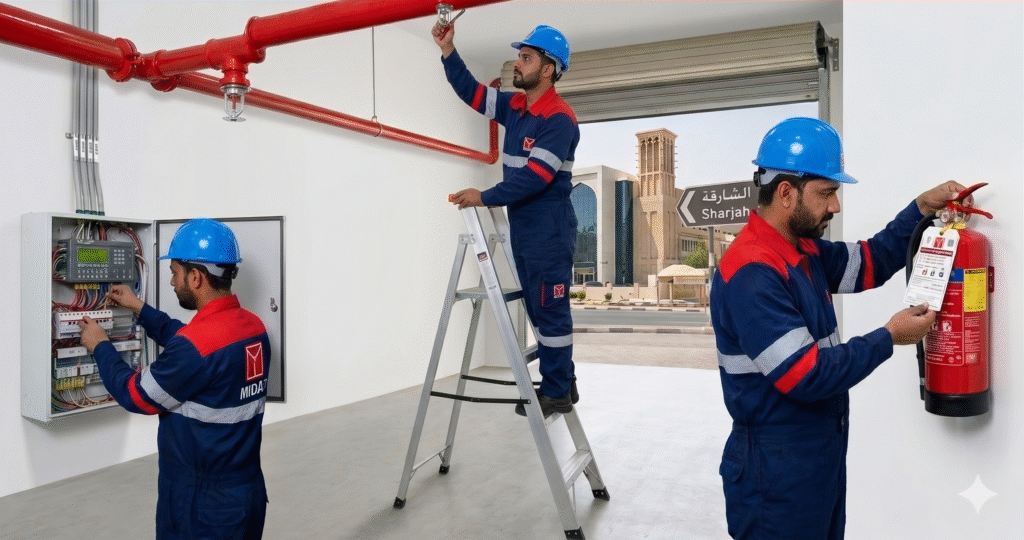
Annual maintenance of all fire protection systems by a civil defence approved contractor, documented in a maintenance log. This includes sprinkler system flushing and pressure testing, fire alarm panel servicing, emergency lighting battery testing, fire extinguisher inspection and recharging, and smoke detector cleaning and sensitivity testing.
For industrial and petroleum projects, additional annual inspection requirements apply, including tank integrity testing, foam concentrate sampling, deluge valve actuation tests, and earthing resistance measurements.
A maintenance compliance report prepared by your civil defence approved contractor is submitted to SCD as part of the renewal application. Failure to renew on time—or renewal rejection due to non-compliant maintenance—exposes the building operator to potential closure notice and personal liability if a fire incident occurs during the lapsed period.
Frequently Asked Questions — Civil Defence Décor Approval Sharjah
No. You can undertake structural and demolition works under the SBCA permit, but you must not install any fire protection system components—sprinkler pipes, detection cables, suppression equipment—before receiving the SCD drawing approval. Starting installation before approval risks rejection of the entire installation on inspection.
A contractor registered with Dubai Civil Defence is not automatically approved to submit to or work under Sharjah Civil Defence. They must hold a separate, active Sharjah registration. This distinction is frequently overlooked when project owners bring in contractors they have used successfully on Dubai projects.
Yes, in most cases. Any modification to an existing fit-out that affects means of egress, fire compartmentation, or requires cutting through a fire-rated element requires SCD approval. Even installing a partition that changes the travel distance to an exit technically requires an amended drawing submission. In practice, SCD’s enforcement focus is proportionate to the scale and hazard of the works, but the legal obligation exists regardless.
Occupying a commercial or industrial premises without a valid civil defence completion certificate is a violation of UAE federal law and Sharjah Emirate regulations. Consequences include fines, forced closure of the premises, inability to renew the trade licence, and personal criminal liability for the licensee in the event of a fire incident. Insurance policies are also voidable in the event of a loss where it can be demonstrated that civil defence approval was absent.
Restaurant and F&B fit-outs attract additional scrutiny from SCD because of the combination of cooking equipment fire risk, high occupant density, and complex egress requirements. Kitchen hood suppression systems (Ansul or equivalent wet chemical systems) must be designed, installed, and maintained by civil defence approved contractors and are subject to a separate approval track within SCD alongside the main décor approval. Do not underestimate the complexity of a restaurant fit-out civil defence submission in Sharjah
Summary — Key Takeaways for Your Sharjah Civil Defence Décor Approval
Getting civil defence décor approval in Sharjah successfully and on schedule comes down to three things: appointing the right civil defence approved contractor from day one, understanding the full multi-authority approval landscape for your specific project type, and building realistic timelines that account for plan review cycles and inspection scheduling.
For industrial projects, and especially for petroleum and chemical storage facilities, the process extends well beyond a standard fire code submission. You are navigating a coordinated approval sequence involving SCD, free zone authorities, the Supreme Council for Energy, and potentially Sharjah Police—each with their own technical requirements and review timelines. A contractor like Midas Electromechanical, with deep experience across Sharjah’s industrial sectors and active civil defence approval status, can guide that coordination and represent your project effectively with each authority.
Start the civil defence process earlier than you think you need to. Commission your approved contractor before construction is complete so that drawings are in review while site works are ongoing. Treat the SCD completion certificate as a parallel critical path item, not an afterthought to be sorted once the build is done.
Do that, and the approval process becomes a manageable, predictable part of your project—not the source of delay and cost that it is for those who approach it unprepared.