By Midas Electromechanical Contracting LLC · SAIF Zone, Sharjah, UAE · 12 min read
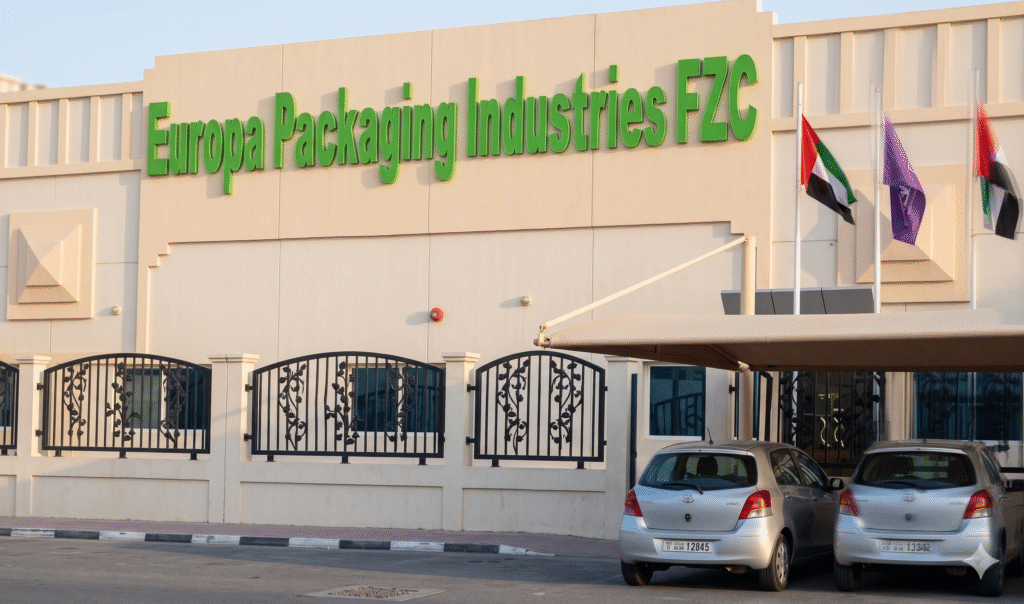
When Europa Packaging decided to expand its production operations at its warehouse facility in the Sharjah Airport International Free Zone (SAIF Zone), the company faced a challenge that is more common than many industrial operators realise: their existing power supply was simply not large enough to run the new machinery they had purchased.
Their existing connection — a 500 kVA supply feeding the facility — could not support the 606 kW demand of the new equipment. A full power infrastructure upgrade was needed, and it had to be completed without shutting down their operational facility.
This case study documents exactly how Midas Electromechanical Contracting LLC managed that upgrade from first assessment to final energization — covering the SEWA approval procedure, the physical challenges of modifying a live LV room, and every document required along the way.
If your facility in SAIF Zone, Hamriyah Free Zone, or Sharjah’s industrial areas is approaching its power limits — or if you are planning new machinery that will exceed your current supply — this article gives you a detailed, real-world picture of what the upgrade process looks like.
About Europa Packaging
Europa Packaging LLC is a packaging manufacturer operating from a warehouse production facility within SAIF Zone, Sharjah. The company required a major power upgrade to commission new high-load production machinery as part of a capacity expansion program.
Project snapshot
| Category | Before upgrade | After upgrade |
|---|---|---|
| Client | Europa Packaging LLC | Europa Packaging LLC |
| Location | SAIF Zone, Sharjah | SAIF Zone, Sharjah |
| Facility type | Warehouse with production floor | Warehouse with production floor |
| Connected load | 500 kVA | 1,500 kVA |
| Transformer | 1 × 500 kVA | 1 × 1,500 kVA (procured and installed by SEWA) |
| LV room | Existing room | Existing room modified — cable trench enlarged, LV board upgraded |
| Supply authority | SEWA | SEWA |
| Approvals required | — | SAIF Zone NOC + SEWA LV upgrade approval |
| Project duration | — | More than 6 months (facility live throughout) |
1. The challenge: new machinery, insufficient power
Europa Packaging’s facility in SAIF Zone was running on a 500 kVA supply — adequate for their existing operations at the time. When the company decided to invest in new production machinery with a total connected load of 606 kW, their existing power infrastructure immediately became the bottleneck.
To understand why, consider the relationship between kilowatts and kilovolt-amperes. A 606 kW load, accounting for a standard industrial power factor of approximately 0.85, translates to a required supply capacity of roughly 713 kVA. The existing 500 kVA supply was already operating near its rated capacity with the facility’s existing loads — adding another 713 kVA on top was not possible without a full infrastructure upgrade.
The required solution was a new 1,500 kVA transformer — tripling the site’s power capacity — along with all the civil modifications, authority approvals, and electrical works that come with it. The total scope covered:
- Enlarging the cable trench in the existing LV room to accommodate the new supply
- Upgrading the LV distribution board and switchgear to match the new 1,500 kVA output
- Obtaining SAIF Zone NOC for the civil modification works within the facility
- Obtaining SEWA approval for the LV upgrade through the full shop drawing submission
- SEWA procuring and installing the new 1,500 kVA transformer
- Midas completing all LV works from the transformer terminals to the LV panel
The critical constraint
Europa Packaging’s facility was fully operational throughout the entire project. Production could not stop. This meant every phase of the works had to be planned, sequenced, and executed around live machinery, active staff, and ongoing shift operations — significantly increasing the complexity and responsibility on the engineering and site teams.
2. Understanding how SEWA works in SAIF Zone: the LV scope explained
One of the most important things to understand about a power upgrade in SAIF Zone is how SEWA divides responsibility between their own team and the appointed electrical contractor. This division is clear, fixed, and non-negotiable — and misunderstanding it is one of the most common causes of scope confusion on upgrade projects.
In SEWA’s framework, everything from the transformer room onwards is classified as LV scope. The transformer itself, and all works on the high voltage network side, are handled exclusively by SEWA’s own engineers. The appointed contractor’s scope begins at the transformer’s LV terminals and covers all works from there to the LV distribution panel and into the facility.
- SEWA’s scope: Transformer procurement, delivery, and installation. All HV network works. Energization.
- Midas’s scope: LV room civil modifications, LV cable works from transformer terminals to the LV panel, LV distribution board and switchgear replacement, earthing and bonding, all downstream electrical works within the facility.
Why this matters for your project planning
When scoping a power upgrade, your electrical contractor is responsible for the LV room modifications and all LV works only. SEWA independently manages the transformer and HV network. Both workstreams need to be coordinated in terms of timing — but they are executed separately. Your contractor should brief you clearly on this division before any works begin.
3. Drawing preparation: Midas and the consultant
For a project involving civil modification works requiring a SAIF Zone building permit, the drawing package must be stamped by a licensed consultant as engineer of record. Europa Packaging appointed an independent consultant for this purpose. Midas prepared the full drawing package in close consultation with the appointed consultant — incorporating our hands-on knowledge of the LV room conditions, existing cable routes, and SEWA’s current submission requirements directly into the drawings from the outset.
The result was a coordinated package that required minimal revision before being accepted by both SAIF Zone and SEWA.
When do you need a consultant?
A consultant is required when civil works need a new building permit — for example, constructing a new LV room, making structural modifications requiring a fresh BP from SAIF Zone or Sharjah Municipality, or on new build projects. For a purely electrical upgrade with no structural changes, Midas — as a SEWA Grade 1 approved contractor — can prepare and submit all drawings independently without a separately appointed consultant.
4. Complete document checklist for a SAIF Zone power upgrade
The table below lists every document required, organised in the order they are needed across the approval and execution process.
| # | Document / Requirement | Submitted to | Prepared by |
|---|---|---|---|
| — | Stage 1 — Initial application documents | ||
| 1 | Existing SEWA connection details and current account number | SEWA | Client |
| 2 | Client’s SAIF Zone lease agreement (valid and current) | SAIF Zone / SEWA | Client |
| 3 | SAIF Zone trade licence (valid) | SAIF Zone + SEWA | Client |
| 4 | Contractor’s SAIF Zone registration certificate (valid) | SAIF Zone | Midas Electromechanical |
| 5 | Contractor’s SEWA Grade 1 registration card (valid) | SEWA | Midas Electromechanical |
| 6 | Contractor’s trade licence — Sharjah Economic Development Dept | SEWA + SAIF Zone | Midas Electromechanical |
| — | Stage 2 — SAIF Zone NOC (required before shop drawing submission to SEWA) | ||
| 7 | Load calculation report — existing loads + new machinery load schedule | SAIF Zone + SEWA | Midas (+ Consultant stamp if BP required) |
| 8 | Preliminary single-line diagram — proposed 1,500 kVA LV configuration | SAIF Zone | Midas (+ Consultant stamp if BP required) |
| 9 | SAIF Zone NOC / building permit for LV room civil modification works | SEWA (copy required) | SAIF Zone Engineering (issued to client) |
| — | Stage 3 — Shop drawing package (full submission to SEWA after NOC) | ||
| 10 | Full shop drawing package Single coordinated submission· Electrical single-line diagram (SLD) — final 1,500 kVA LV configuration · LV distribution board layout and DB schedules · LV room civil modification drawings — cable trench enlargement details · LV cable routing drawing — transformer terminals to main LV panel · Switchgear drawing — incomer, busbars, outgoing circuit arrangement · Earthing and bonding schematic · Cable schedule with sizes and ratings | SEWA | Midas (stamped by Consultant if BP was required) |
| — | Stage 4 — Payment and execution | ||
| 11 | SEWA application form for LV load upgrade | SEWA | Midas on behalf of client |
| 12 | Payment confirmation — SEWA transformer and connection charges | SEWA | Client (payment) |
Note on the shop drawing package
SEWA requires the complete shop drawing package to be submitted together as a single coordinated set after the SAIF Zone NOC is in hand. Submitting drawings piecemeal causes delays and resubmissions. Midas prepares the full package — including the switchgear drawing — as one integrated submission, ensuring SEWA’s engineering review can proceed without interruption.
5. Step-by-step: how the project was executed
The full project ran for more than six months from initial assessment to energization. Below is the complete phase-by-phase breakdown.
| Phase | What happened | Who was involved |
|---|---|---|
| Phase 1 Site assessment | Midas engineers visited the Europa Packaging facility to carry out a full load assessment. Existing supply capacity, LV board condition, cable sizes, and LV room dimensions were surveyed. The 606 kW machinery requirement was translated into a 1,500 kVA supply specification. | Midas engineering team |
| Phase 2 Consultant appointment | Europa Packaging appointed an independent electrical and civil consultant as engineer of record, required for the SAIF Zone building permit. Midas provided the technical brief — room survey data, existing single-line diagram, SEWA account details, and the 1,500 kVA specification — to form the basis of the design package. | Client + Consultant |
| Phase 3 Drawing preparation | Midas prepared the full drawing package in close consultation with the appointed consultant. This included the preliminary SLD and load calculation report for the SAIF Zone NOC application, and the complete shop drawing package for SEWA — covering the SLD, LV room civil drawings, LV cable routing, LV DB layout, switchgear drawing, earthing schematic, and cable schedule. The package was stamped by the consultant. | Midas + Consultant (stamp) |
| Phase 4 SAIF Zone NOC | The preliminary drawings and load calculation were submitted to SAIF Zone for review. SAIF Zone issued the NOC authorising the LV room civil modification works — specifically the cable trench enlargement. This NOC is a prerequisite before SEWA will accept the shop drawing submission.SEWA requires a copy of the SAIF Zone NOC before proceeding with the LV upgrade approval. | Client + Midas + SAIF Zone |
| Phase 5 SEWA approval | With the SAIF Zone NOC secured, the complete shop drawing package was submitted to SEWA as a single coordinated submission. SEWA’s engineering department reviewed the full package and issued approval for the LV upgrade works to proceed. | Midas + SEWA Engineering |
| Phase 6 Civil modification — LV room | With both approvals in hand, civil works began on the LV room. The existing cable trench was enlarged to accommodate the heavier LV cables required for the 1,500 kVA supply. The transformer plinth was modified to match the footprint of the new, larger unit. All civil works were executed to the approved drawings.Facility remained fully operational throughout — works were sequenced carefully to isolate the LV room from the production floor at all times. | Midas civil team |
| Phase 7 LV electrical works | The existing LV distribution board and switchgear were decommissioned and replaced with a new board and switchgear rated for the 1,500 kVA supply output. New LV busbars, LV cables from the transformer terminals to the main panel, and cable tray extensions were installed. The existing 500 kVA transformer was isolated and removed — transformer removal is coordinated with SEWA as it is their asset. | Midas electrical team |
| Phase 8 SEWA transformer installation | SEWA’s own team procured, delivered, and installed the new 1,500 kVA transformer. All works on the transformer itself and the HV network side are carried out exclusively by SEWA — entirely outside the contractor’s scope. Midas’s LV works recommenced once the transformer was in place and ready for LV termination. | SEWA (exclusively) |
| Phase 9 LV termination & checks | Midas completed the LV cable terminations from the transformer’s LV terminals to the main LV distribution board. Earth continuity, loop impedance, and LV board functional tests were carried out and documented. | Midas electrical team |
| Phase 10 SEWA inspection | A SEWA inspection engineer visited site to verify all LV works matched the approved shop drawings and that the LV room met SEWA’s technical standards. The inspection covered the LV board and switchgear arrangement, LV cable installation, earthing system, and protection devices. | SEWA inspection engineer |
| Phase 11 Energization | Following successful inspection, SEWA energized the new 1,500 kVA supply. Europa Packaging’s facility was now operating on a supply three times its previous capacity — with the new production machinery ready to be commissioned. | SEWA operations team |
| Phase 12 Post-energization | Midas carried out post-energization checks with the new machinery loads connected. The new production equipment was progressively brought online, load levels were monitored, and all systems confirmed stable. | Midas + Europa Packaging operations |
6. The live-site challenge: working around a fully operational facility
Of all the complexities on this project, the most demanding was executing a full LV room overhaul inside a facility that could not stop production. Here is how Midas managed it.
Detailed sequencing of works
Every phase of the physical works was mapped against Europa Packaging’s production schedule. Heavy civil works — breaking out the cable trench, modifying the transformer plinth — were scheduled during planned maintenance windows or low-production periods.
Temporary supply planning
Before the existing supply was taken offline for the LV board replacement, Midas arranged temporary power provisions for the facility’s critical loads — ensuring that essential services including lighting, safety systems, and IT infrastructure remained live throughout the switchover period.
Dust and vibration control
The LV room is adjacent to active production areas. All civil works were conducted with dust containment screens and vibration monitoring to ensure no impact on production quality or equipment.
Daily coordination with facility management
Midas’s site supervisor maintained daily communication with Europa Packaging’s facility manager throughout the execution phase. Every planned power interruption was agreed at least 24 hours in advance, documented, and communicated to all department heads before it occurred.
Safety protocol during LV works
All LV works involving isolation of live systems were conducted under strict permit-to-work (PTW) procedures. A dedicated Midas safety officer was present on site during all critical LV activities.
Key lesson for facility operators
The live-site constraint is the most underestimated challenge in a power upgrade project. If your facility cannot afford a full shutdown, your contractor must have a specific, documented plan for temporary supply, phased isolation, and daily coordination with your operations team — before any work starts. Midas builds this plan as part of the project scope, not as an afterthought.
7. What was modified in the LV room
Cable trench enlargement
The existing cable trench was sized for the original 500 kVA installation. A 1,500 kVA supply requires significantly heavier LV cables with a larger cross-sectional area to handle the higher current safely. The trench was broken out, widened, and deepened to the dimensions specified in the approved shop drawings.
Transformer plinth modification
The concrete plinth was adapted to match the footprint of the new 1,500 kVA unit. A 1,500 kVA oil-type transformer weighs approximately 3,200 to 3,500 kg — compared to roughly 1,400 to 1,600 kg for the outgoing 500 kVA unit. The plinth was rebuilt and reinforced accordingly.
LV distribution board and switchgear replacement
The existing LV board was rated for the 500 kVA supply. With the new transformer delivering up to 2,085 amperes at 415V full load, the entire LV board — including the main incomer, switchgear, busbars, outgoing distribution circuits, and metering — was replaced with a new assembly rated to SEWA’s current LV panel standards.
LV cable replacement
The LV cables running from the transformer terminals to the main distribution board were replaced with new cables correctly sized for the 1,500 kVA supply. Correct LV cable sizing is critical — undersized cables cause voltage drop, overheating, and protection issues under full load.
Earthing system upgrade
The facility’s earthing and bonding system was reviewed and upgraded to be consistent with the new supply capacity and SEWA’s earthing requirements. Earth electrode resistance was tested before and after the upgrade to confirm compliance.
8. The SEWA cost that every client must budget for
One aspect of power upgrades that consistently surprises clients is that SEWA charges for the transformer itself — and this cost is the client’s responsibility, not SEWA’s. When SEWA installs a new transformer as part of a supply upgrade, the cost of that transformer is billed directly to the client as part of the connection upgrade process. For a 1,500 kVA transformer, this represents a significant line item in the project budget that must be planned for from day one.
Clients must settle this SEWA charge before the final energization can proceed — it is a hard prerequisite.
Budgeting for SEWA’s connection charges
For a detailed breakdown of SEWA’s connection fees and transformer charges for LV industrial connections in Sharjah, read our dedicated guide: SEWA Fees in Sharjah — A Comprehensive Guide for Contractors and Clients. (midasec.com/sewa-connection-fees/)
9. The outcome: new machinery online, production capacity expanded
Following more than six months of planning, approvals, civil works, electrical installation, and coordination with SEWA — conducted without a single day of forced production shutdown — Europa Packaging’s 1,500 kVA supply was energized.
The new production machinery was commissioned and brought online. The facility now operates on a supply three times its previous capacity — with the headroom to absorb future load additions without requiring another full upgrade.
For Europa Packaging, the outcome was straightforward: the machinery they had invested in was running, and the production capacity expansion they had planned was operational. The power infrastructure that had been the constraint was no longer a limiting factor.
10. Is your facility approaching its power limit?
The Europa Packaging project is not unusual. Across SAIF Zone, Hamriyah Free Zone, and Sharjah’s mainland industrial areas, facilities regularly reach the point where their original power supply can no longer support their growth. Here are the signs that your facility may be approaching that point:
- Your new machinery specification exceeds what your current supply can deliver
- Your SEWA bill shows consistently high maximum demand charges — a sign you are near your approved load
- You experience voltage dips or tripping when multiple large loads run simultaneously
- You are planning a production line expansion, new HVAC system, or additional process equipment
- Your facility manager has told you the existing supply is “at capacity”
If any of these apply, the time to assess your power supply situation is before you purchase new equipment — not after it arrives on site. The Europa Packaging project took more than six months from first assessment to energization. Starting the process early is the single most effective way to avoid delays to your production plans.
Based on our experience, a project involving a supply upgrade from 500 kVA to 1,500 kVA — including LV room modification, SAIF Zone NOC, SEWA approval, and SEWA transformer installation — typically takes between four and eight months from the initial site assessment to final energization. The Europa Packaging project ran for more than six months. The longest stages are the SAIF Zone NOC process, SEWA shop drawing approval, and SEWA’s own transformer procurement and installation schedule. Starting the process as early as possible — ideally before you purchase the new machinery — is the most effective way to avoid timeline pressure.
SEWA installs the transformer. In SEWA’s operational framework, the transformer and all works on the HV network side are carried out exclusively by SEWA’s own engineers. The appointed contractor’s scope begins at the transformer’s LV terminals and covers all LV works from there to the main distribution panel and into the facility. This is a clear and fixed boundary. Understanding this division from the start of the project is essential for accurate scope definition and budgeting.
Not necessarily. For a straightforward power upgrade — where the works involve LV electrical changes only and no new building permit or civil approvals are required — Midas can manage the full scope independently as a SEWA Grade 1 approved contractor. This includes preparing and submitting all drawings required by SEWA without a separately appointed consultant.
A consultant is required when the project involves civil works that need a new building permit — for example, constructing a new LV room, making structural modifications requiring a fresh BP from SAIF Zone or Sharjah Municipality, or on new build projects. In the Europa Packaging project, a consultant was appointed because the LV room civil modification required a SAIF Zone building permit. If your upgrade is electrical only with no structural changes, Midas can handle everything from assessment to energization directly.
The client pays. When SEWA installs a new transformer as part of a supply upgrade, the cost of the transformer is charged directly to the client. This is a significant project cost that must be budgeted from the outset. The exact amount depends on SEWA’s current fee schedule and the transformer rating. Your contractor can provide an indicative figure based on the upgrade specification during the initial assessment phase.
Yes — but it requires careful planning, documented temporary supply arrangements, and daily coordination between the contractor and the facility’s operations team. The Europa Packaging project was executed with the facility fully operational throughout. Midas planned the works in phases, arranged temporary power for critical loads during switchover periods, and agreed every planned interruption with the client’s facility manager in advance. Executing a supply upgrade on a live industrial site requires a contractor with specific experience in live-site LV works and a well-structured execution plan.
SAIF Zone requires its own NOC (No Objection Certificate) for any structural or civil modification carried out within a leased facility. For a power upgrade that involves enlarging the cable trench or making any other civil change to the LV room, a SAIF Zone NOC must be obtained before those works can begin. SEWA also requires a copy of the SAIF Zone NOC before accepting the shop drawing submission. Midas manages the NOC application process on behalf of the client as part of the project scope. Note: for a purely electrical upgrade with no civil works, the SAIF Zone NOC requirement may not apply — your contractor will confirm based on the specific scope.
A SEWA Grade 1 contractor is required for LV works associated with a supply of 1,500 kVA and above. Grade 2 contractors are limited to lower capacity ranges and cannot legally carry out or certify LV works at this level. Midas Electromechanical Contracting LLC holds SEWA Grade 1 status — the highest SEWA contractor classification. Always confirm your contractor’s SEWA grade before appointing them for a supply upgrade of this scale.
The decommissioned transformer is removed by SEWA as part of their scope, since the transformer is SEWA’s asset. The removal is coordinated between Midas and SEWA’s operations team as part of the overall project sequencing. On the LV side, the old LV cables, distribution board, and switchgear are removed by Midas and disposed of in accordance with UAE regulations.
SAIF Zone is served solely by SEWA — the Sharjah Electricity, Water and Gas Authority. Etihad Water and Electricity is not involved in SAIF Zone power connections or upgrades. All applications, approvals, transformer installations, and energization for facilities within SAIF Zone go through SEWA exclusively.