For many villa owners in Sharjah—whether you have just completed a brand-new build or purchased a property from a developer—the dream of moving in often hits a frustrating roadblock: the power connection. While online guides frequently focus on the simple process of transferring an existing meter from one tenant to another, the reality for new villa owners is fundamentally different. Obtaining a permanent electricity connection for a villa in Sharjah is a technical, multi-stage process that requires professional engineering oversight, strict adherence to Sharjah Electricity, Water and Gas Authority (SEWA) regulations, and formal inspections.
If you are looking to get your villa energized, this guide provides the clarity, technical roadmap, and professional insight you need to navigate the SEWA process efficiently.
The Difference Between “Moving In” and Getting a Permanent Connection
It is critical to distinguish between transferring a connection and establishing a new one.
- Utility Transfer: This is a routine administrative task for tenants or buyers moving into an existing house where the power is already active.
- Permanent Electricity Connection: This is a physical and legal process. It involves installing a new meter, connecting your villa to the Sharjah power grid, and ensuring your internal electrical system meets national safety standards.
Power connection delays are a leading cause of postponed handovers. Understanding the workflow early is the best way to ensure your move-in date doesn’t slip.
1. Who is Responsible: Owner or Contractor?
One of the most common misconceptions is that the villa owner can handle the application process alone. In reality, a SEWA-approved electrical contractor is mandatory.
SEWA requires that all electrical design, installation, and inspection requests be submitted by a firm certified by their technical department. These contractors are categorized by “Grades.” For standard residential villas, a Grade 3 or Grade 4 electrical contractor is typically sufficient to handle the load calculations and site works.
- Your Role: You act as the facilitator—providing the necessary property documents and paying the requisite fees.
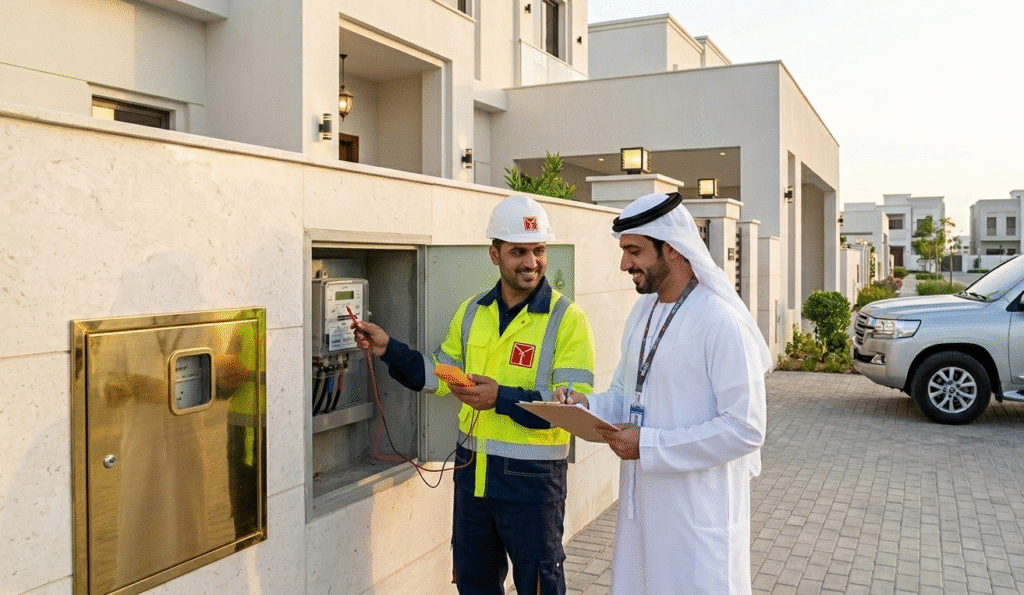
- The Contractor’s Role (e.g., Midas Electromechanical): They act as your representative, handling the technical drawings, liaising with SEWA engineers, managing the inspection scheduling, and ensuring your home’s wiring is compliant.
2. Documents You Need to Prepare: Owner’s Checklist
Before you engage with the SEWA portal or your contractor, gather the following documents. Having these organized will significantly speed up the initial assessment:
- Title Deed (Toop): The official proof of ownership for the land/villa.
- Affection Plan (Khareeta): The official site plan issued by the Sharjah Municipality.
- Building Permit: The official authorization from the Sharjah Municipality allowing construction. This is a primary requirement for the initial connection request.
- Emirates ID: Original and copy of the owner.
- Approved Electrical Drawings: Detailed schematics of your villa’s load, wiring, and distribution boards.
- Contractor’s Trade License: Your chosen firm’s valid license, specifically showing their SEWA approval/classification.
3. Step-by-Step Process: From Drawing Approval to
The journey from a “cold” site to an energized villa happens in five distinct phases.
Phase 1: Planning and Design
Your contractor prepares the Electrical Load Calculation based on your villa’s size and appliance requirements. These drawings are submitted to SEWA for approval. This confirms your villa is compatible with the grid capacity in your area.
Phase 2: Internal Installation
Once drawings are approved, the electrical contractor completes the internal wiring, installs the distribution boards, and sets up the meter cabinet (often located at the boundary wall).
Phase 3: Application for Inspection
The contractor submits a “Request for Inspection” through the SEWA portal once the wiring is verified on-site.
Phase 4: SEWA Site Inspection
A SEWA engineer will visit the villa to perform a physical inspection. They look for compliance with the approved drawings, quality of materials (cables, circuit breakers), and overall safety.
Phase 5: Meter Installation and Energization
Once the inspection report is “Passed,” you pay the connection fees. SEWA technicians will then install the meter, and the power will be switched on.
Timeline Estimate: Generally, from the date of initial drawing submission to final power-on, the process takes between 3 to 6 weeks, provided there are no failed inspections.
4. SEWA Fees for Villa Electricity Connections in Sharjah
Connection fees are determined by the connected load of your villa, measured in kilo-Volt-Amperes (kVA).
- Connection Fee: This is a one-time charge per kVA.
- Security Deposit: This is a refundable amount held by SEWA. For villas, this amount is determined by the size and expected consumption of the property.
- Service Charges: Minor administrative fees for the file opening and meter installation.
For a detailed breakdown of current cost-per-kVA rates and calculators, please visit our dedicated https://midasec.com/sewa-connection-fees/
5. Common Reasons for Rejection and How to Avoid Them
Even with a contractor, applications can be rejected. Here is how to avoid the most common “red flags”:
- Drawing Mismatches: If the contractor installs a socket or a distribution board in a location different from the approved drawing, the inspection will fail immediately.
- Expired Approvals: Ensure your contractor uses the most recent version of your architectural plans.
- Unlicensed Contractors: Never be tempted to use a “handyman” or an uncertified contractor to save costs. SEWA will simply not accept the request, leading to massive delays.
- Missing Building Permit: Ensure your building permit is active and clearly linked to the specific plot number to prevent administrative stalls.
6. How to Apply: Online vs. In-Person
While most of the technical heavy lifting is done via the SEWA E-Portal, you may occasionally need to visit a Customer Happiness Centre.
- SEWA E-Portal: This is the primary channel. Your contractor will log in to submit documents and track the status of the “Connection Request.”
- SEWA App: Useful for tracking the status of your application once the file number has been generated.
- Customer Happiness Centers: Located across Sharjah. You would typically only visit these to finalize payment or provide original physical documents if specifically requested.
7. FAQ: 8 Questions Villa Owners Commonly Ask
Q: Can I apply myself without a contractor? A: No. SEWA requires an accredited contractor to take technical responsibility for the installation.
Q: How long does the entire process take? A: Excluding the time taken to build the villa, the formal SEWA process takes roughly 3–6 weeks.
Q: What if my electrical needs change after drawing approval? A: You must submit a “Revision Request” to SEWA. Never change the wiring on-site without prior approval.
Q: How is the villa load calculated? A: It is based on the total wattage of all planned air conditioning, lighting, kitchen appliances, and motor pumps.
Q: Is the security deposit refundable? A: Yes, it is fully refundable if you ever move out or disconnect the service, provided all final bills are settled.
Q: What if the inspection fails? A: The engineer will provide a “snag list.” Your contractor must rectify these specific issues and then request a “Re-inspection.”
Q: Does the size of the villa affect the cost? A: Yes, larger villas have higher load requirements (kVA), which increases the connection fees.
Q: Are there seasonal delays? A: Yes, during peak construction periods or summer, inspection appointments may be slightly delayed.
Need Help Navigating Your SEWA Connection?
At Midas Electromechanical, we specialize in helping Sharjah homeowners transition smoothly into their new villas. As a SEWA-approved grade 1 contractor, we manage the technical documentation, coordinate inspections, and ensure your project meets all regulatory standards on the first attempt.